Architecture Overview & Data Flow
K0maru-Agent-Memory enforces a 4-layer decoupled architecture designed specifically for AI coding agents. Through strict layer boundaries and zero background daemons, it achieves sub-5ms cold starts and robust runtime stability.
🏗 4-Layer Decoupled Architecture
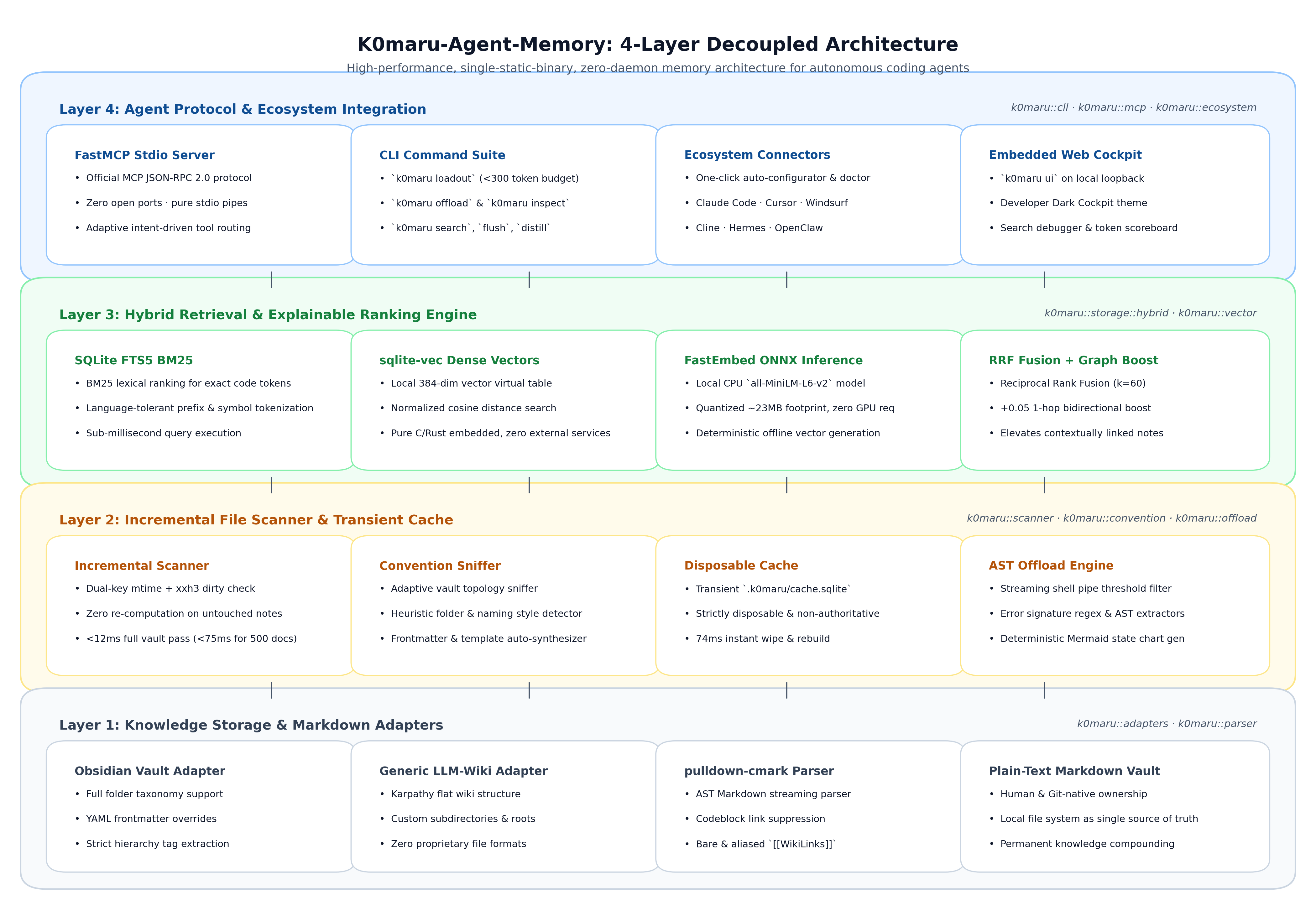
1. Presentation & Protocol Layer
Handles bidirectional communication with developers and external AI agent clients:
- CLI Subsystem: Built on Rust's
clapframework. Powers Unix pipe filtering (| k0maru offload), environment diagnostics (k0maru doctor), bootstrap extraction (k0maru loadout), search, and crystallization commands. - FastMCP Stdio Server: Implements the official Anthropic Model Context Protocol (MCP) standard over standard I/O streams (
stdio) using JSON-RPC 2.0. Requires zero listening network ports and zero background daemons. - Embedded Developer Console (Axum WebUI): Compiles static assets directly into the binary using
axumandrust-embed. Provides interactive retrieval debugging and zero-CDN inline SVG Mermaid rendering, terminating cleanly upon exit.
2. Domain & Processing Layer
Governs business logic, trace syntax analysis, and convention adaptation:
- Incremental Scanner (
IncrementalScanner): Leveragesxxh364-bit hashing and filesystem modification timestamps (mtime) to maintain an in-memory dirty-file state machine, eliminating unnecessary disk I/O. - Adaptive Convention Sniffer (
ConventionSniffer): Detects existing directory topologies (Johnny Decimal vs flat), file naming patterns (date_slugvsslug_only), and YAML frontmatter formats automatically. - Distill Heuristic Engine (
DistillEngine): Parses compiler stack traces and test failures, applying AST heuristics to synthesize reusable troubleshooting playbooks. - Atomic Crystallization Engine (
FlushEngine): Resolves collision suffixes, generates YAML frontmatter, weaves bidirectional[[WikiLinks]], and triggers post-write cache updates.
3. Retrieval & Fusion Layer
Combines exact lexical matching, dense semantic representations, and bidirectional graph connectivity:
- BM25 Lexical Engine: Uses native SQLite FTS5 virtual tables to perform sub-millisecond inverted matching across identifiers, keywords, and error codes.
- ONNX Semantic Engine: Runs local inference via
fastembed-rsandall-MiniLM-L6-v2(384-dimensional dense vectors) to compute semantic embeddings. - RRF Rank Fusion ($k=60$): Blends lexical and semantic score distributions using Reciprocal Rank Fusion.
- 1-Hop WikiLinks Graph Boost (+0.05 Boost): Scans candidate pairs for bidirectional links, elevating hub notes (Maps of Content) in the final ranking.
4. Storage & Persistence Layer
Maintains the invariant that the filesystem is the single source of truth while keeping caches disposable:
- Standard Markdown Filesystem (Source of Truth): Your local Obsidian notes or LLM-Wiki files. All content remains 100% open-standard Markdown versioned with Git.
- Single-File Disposable Cache (
cache.sqlite): Located at.k0maru/cache.sqlite. Houses FTS5 inverted tables andsqlite-vecvirtual tables. You can delete this file at any time; K0maru rebuilds it in 74 ms. - Offline Slice Reference Pool (
.k0maru/refs/): Stores full, untruncated raw compiler traces offloaded from the terminal, retrievable on-demand by Node ID.
💡 Architectural Decision: Why Embedded SQLite?
During early design stages, K0maru evaluated PostgreSQL/pgvector, Qdrant, DuckDB, and dedicated graph databases:
- Structural Accelerator, Not Full-Blown DB: As stated in SQLite's core philosophy ("SQLite does not compete with Oracle. It competes with
fopen()"), SQLite in K0maru is not a heavy server database requiring maintenance, but a superfast structural indexing accelerator for Markdown files.- Zero-Daemon & 3.4ms Cold Start: Server databases consume 1GB+ RAM and occupy TCP ports. In contrast, SQLite is statically embedded into a single binary (3.6 MB pure-Rust core / 19 MB macOS arm64 / 34 MB Linux x86_64), cold-starts in 3.4ms, consumes only ~11.7MB RAM, and releases resources immediately upon process exit.
- Homogeneous Hybrid Retrieval: SQLite FTS5 (BM25 lexical matching) and
sqlite-vec(cosine vector search) operate inside the exact same database file and connection, completely eliminating cross-network latency and two-phase commit inconsistencies.- Sub-millisecond Graph Traversal: Traversing
[[WikiLinks]]across 1-hop and 2-hop topological neighbors via indexed relation tables takes <0.05ms, vastly faster than serializing queries over network graph databases.- Disposable & Instant Self-Healing: Deleting
cache.sqlitecauses no data loss; the scanner rebuilds the entire index from Markdown files at 6,700+ docs/sec in ~74ms.
📚 4-Tier Memory Hierarchy (L0–L3)
K0maru organizes all software development knowledge into a 4-tier memory pyramid:
graph TD
    L3["L3 Evergreen Cards<br/>(Architecture invariants, ADRs, system rules)"]
    L2["L2 Decision Logs<br/>(Sprint records, incident postmortems, milestones)"]
    L1["L1 External Resources<br/>(Third-party API specs, vendor docs, bookmarks)"]
    L0["L0 Scratch / Dailies<br/>(Terminal dumps, raw stack traces, scratch notes)"]

    L3 --- L2
    L2 --- L1
    L1 --- L0

    style L3 fill:#15803d,stroke:#22c55e,color:#fff
    style L2 fill:#1e40af,stroke:#3b82f6,color:#fff
    style L1 fill:#854d0e,stroke:#eab308,color:#fff
    style L0 fill:#334155,stroke:#64748b,color:#fff
1. L3 Evergreen (Invariants & Architecture Decisions)
- Locations:
20_Cards/,docs/adr/,concepts/ - Definition: High-value, rarely changing rules and architectural decision records (ADRs) that every session must observe.
- Example:
adr-008-distributed-lock.md(mandates RedisSET NX EX 30mutex locks and state machine idempotency guards).
2. L2 Decision Logs (Milestones & Incident Postmortems)
- Locations:
00_Logs/,logs/,journal/ - Definition: Historical accounts of resolved incidents, sprint iterations, or feature milestones.
- Example:
2026-10-08-incident-retry-storm.md(documents root-cause analysis and workarounds for webhook retry storms).
3. L1 Resources (External Specifications & API Guides)
- Locations:
30_Resources/,specs/ - Definition: Third-party API schemas, vendor specifications, and team conventions.
- Example:
stripe-webhook-v2024-api.md.
4. L0 Scratch / Dailies (Ephemeral Traces & Slices)
- Locations:
.scratch/,.k0maru/refs/ - Definition: Raw stack trace slices and transient scratch notes offloaded from terminal output. Has a short lifespan and can be cleaned or overwritten automatically.
🔄 Memory Lifecycle Closed-Loop
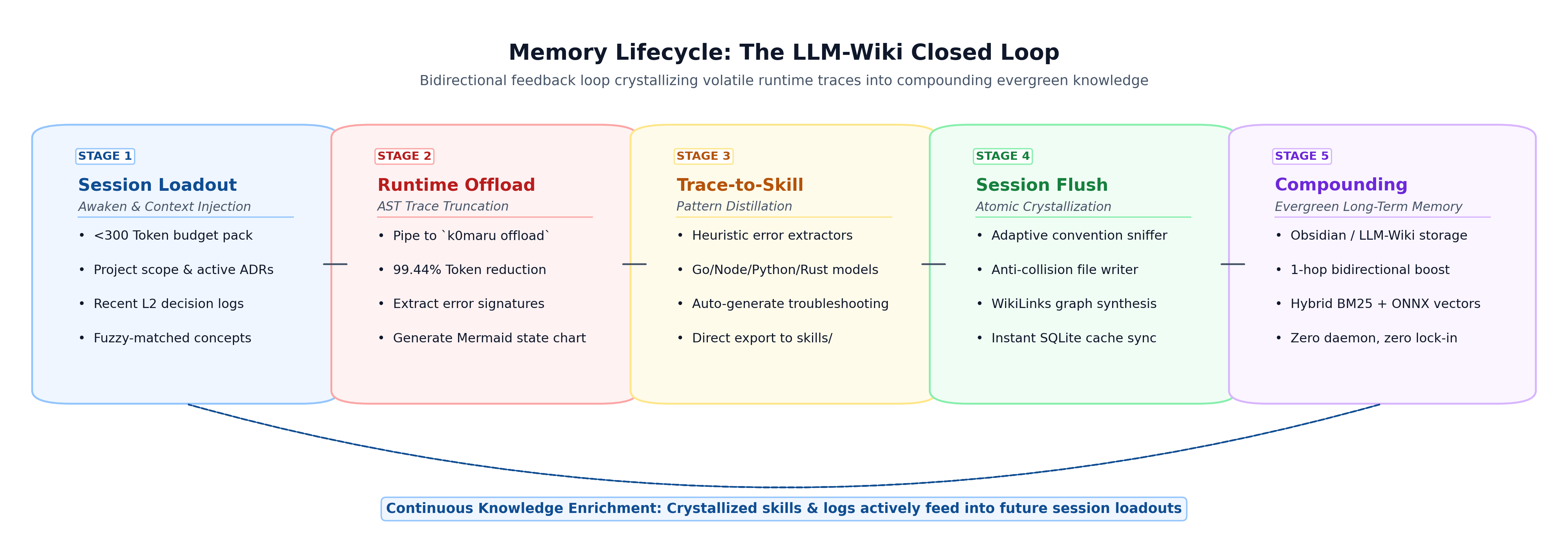
The sequence diagram below illustrates how knowledge compounds across agent sessions:
sequenceDiagram
    autonumber
    actor Developer as Developer / Master Agent
    participant Agent as AI Coding Agent
    participant K0maru as K0maru Memory Hub
    participant Vault as Local Markdown Vault
    participant Cache as cache.sqlite Transient Cache

    Note over Developer,Agent: Stage 1: Bootstrap & Context Loadout
    Developer->>Agent: Assign development ticket or bug report
    Agent->>K0maru: Call get_project_loadout(project)
    K0maru->>Cache: Millisecond dirty check & cache read
    K0maru-->>Agent: Return <300 token project vision & L3 invariants

    Note over Agent,K0maru: Stage 2: Execution & Log Governance
    Agent->>Developer: Run build or test suite (produces 1,000+ line crash)
    Developer->>K0maru: Pipe filter (cargo test 2>&1 | k0maru offload)
    K0maru-->>Agent: Output 15-line Mermaid state diagram + Node ID
    opt Inspect stack details on-demand
        Agent->>K0maru: Call inspect_log_node(node_id)
        K0maru-->>Agent: Return targeted stack trace slice
    end

    Note over Agent,Vault: Stage 3: Decision Crystallization & Self-Healing
    Agent->>Developer: Patch bug and pass all tests
    Agent->>K0maru: Call flush_session(title, content, related_notes)
    K0maru->>Vault: Atomically write Markdown note with [[WikiLinks]]
    K0maru->>Cache: Incremental cache update in <5ms
    K0maru-->>Agent: Confirm successful crystallization

    Note over Agent,K0maru: Stage 4: Instant Recall in Subsequent Sessions
    Agent->>K0maru: Call recall_memory("new incident keyword")
    K0maru-->>Agent: Return crystallized knowledge in 0.88ms
By completing this loop, every troubleshooting breakthrough and architectural decision transforms into a permanent asset that future agent sessions recall in milliseconds.