Key Implementations Deep Dive
This chapter examines the internal mechanics, engineering decisions, and algorithmic implementations powering K0maru-Agent-Memory's 8 core subsystems.
1. xxh3 Incremental Scanner State Machine & 0-I/O Dirty Detection
To deliver millisecond-level cache synchronization across vaults containing thousands of Markdown notes, K0maru eliminates brute-force file traversal and redundant disk I/O.
3-Tier Filtering Pipeline
The incremental scanner (IncrementalScanner) evaluates files through a 3-tier in-memory state machine:
flowchart TD
    DiskFile["Scan finds file on disk"] --> CheckCache{"Exists in SQLite metadata cache?"}
    CheckCache -- "No" --> MarkAdded["Mark as Added ➔ Read full content & index"]
    CheckCache -- "Yes" --> CheckMtime{"Has file mtime changed?"}
    CheckMtime -- "No (99% of files)" --> MarkUnchanged["Mark as Unchanged ➔ 0-I/O skip"]
    CheckMtime -- "Yes" --> CalcXXH3{"Has xxh3 content hash changed?"}
    CalcXXH3 -- "Hash unchanged" --> UpdateMtimeOnly["Update mtime only ➔ Skip re-parsing"]
CalcXXH3 -- "Hash changed" --> MarkModified["Mark as Modified ➔ Re-parse & re-embed"]- Tier 1 (Cache Presence Check): Compares relative file paths against an in-memory hash set warmed from the SQLite
documentstable. Files missing from the set enter theaddedcollection directly. - Tier 2 (mtime Sub-Nanosecond Check): Reads the filesystem modification timestamp (
mtime). For untouched files, this check requires only a singlestat()system call and executes zero content reading I/O. - Tier 3 (xxh3 64-bit Content Digest): If the
mtimechanged, K0maru computes a 64-bit digest using the SIMD-acceleratedxxh3_64algorithm. If the digest matches the cached hash (for example, if you executedtouchwithout modifying text), K0maru updates the storedmtimeand skips tokenization and vector re-embedding.
On a benchmark vault of 500 documents, clean scans complete in 11.67 ms, and cold index reconstruction achieves 6,746 documents per second.
2. Hybrid Retrieval: BM25 + ONNX Vectors + 1-Hop Graph Boost RRF
Pure vector retrieval often hallucinates or drifts when querying precise software symbols (such as SQLITE_BUSY, E0502, or Option<&mut T>). Conversely, pure keyword search cannot recognize synonyms or architectural abstractions. K0maru fuses three retrieval channels.
Mathematical Formulation
For any document $d$ in the candidate set, its composite score is computed via Reciprocal Rank Fusion (RRF) with an additive graph topological boost:
$$\text{Score}{\text{RRF}}(d) = \sum{m \in {\text{BM25}, \text{Vector}}} \frac{w_m}{k + \text{Rank}_m(d)} + \text{GraphBoost}(d)$$
Parameter definitions and production defaults:
- $k$: Smoothing constant set to $k = 60$ (empirically validated on TREC and BEIR benchmarks to stabilize variance among top ranks);
- $w_{\text{BM25}}$ and $w_{\text{Vector}}$: Channel weights normalized to $0.5$ each;
- $\text{Rank}_m(d)$: 1-based rank of document $d$ in channel $m$. If a document fails to enter the top-$N$ pool for a channel, its contribution is $0$;
- $\text{GraphBoost}(d)$: +0.05 topological boost.
1-Hop WikiLinks Bidirectional Graph Boost
After gathering candidate documents (typically limit * 3, with a minimum of 20 notes), the graph engine scans candidate pairs:
- Forward link matching: Verifies whether candidate document $A$ contains a
[[B]]link pointing to candidate document $B$. - Backlink matching: Verifies whether document $B$'s backlink table references document $A$.
If a candidate connects to any other candidate in the pool via a 1-hop link, K0maru adds $+0.05$ to its RRF score. This mechanism elevates foundational hub notes (Maps of Content) and shared architectural standards above isolated leaves.
3. FastMCP Stdio Protocol & Natural Language Intent Mapping
Many agent extensions force developers to memorize rigid trigger keywords. K0maru implements the Anthropic Model Context Protocol (FastMCP) over standard I/O streams (stdio) using asynchronous JSON-RPC 2.0.
Natural Language Intent Routing
K0maru's tool annotations align with natural human phrasing. Leading LLMs (Claude 3.5 Sonnet, GPT-4o, Qwen2.5-Coder, DeepSeek-R1) route conversational prompts to K0maru's native tools autonomously:
| User Conversational Utterance | Inferred Agent Intent | FastMCP Tool Call |
|---|---|---|
| "I am taking over this microservice; show me the core architecture rules." | Bootstrap context loadout | get_project_loadout |
| "How did we resolve this error in past sprints? Check our notes." | Knowledge base search | recall_memory |
| "The test suite dumped a huge crash log; inspect the stack trace." | Log slice retrieval | inspect_log_node |
| "Save our agreed Redis mutex renewal pattern as an ADR." | Decision crystallization | flush_session |
| "Synthesize an automated troubleshooting guide from this compiler trace." | Reusable skill synthesis | distill_session_skill |
Because FastMCP runs over standard stdio pipes spawned on-demand by the agent client, K0maru requires zero open network ports and zero reverse proxies.
4. Symbolic Log Offloading & Zero-Dependency SVG Mermaid Rendering
When tests crash or compiler builds fail, k0maru offload intercepts output streams using an AST-driven streaming parser (OffloadEngine).
Offloading Workflow
- Line-threshold trigger: Triggers when output exceeds 50 lines (configurable via
--threshold). Shorter logs pass through untouched. - Streaming pattern extraction:
- Identifies error codes (such as Rust
E0382/E0502, PythonInvalidStateError, Gofatal error: all goroutines are asleep); - Extracts root file paths and line numbers (such as
src/worker.rs:42).
- Identifies error codes (such as Rust
- Physical slice persistence: Saves raw, uncompressed log traces to
.k0maru/refs/<task_id>_<node_id>.log. - Mermaid state diagram generation: Produces a 15-line Mermaid state diagram for terminal output, reducing token consumption by 97% to 99.4%.
Zero-Dependency Inline SVG Rendering
Within the embedded developer console, K0maru converts Mermaid syntax directly into inline SVG elements using a lightweight internal parser. The console operates without headless browser instances, Node.js runtimes, or external CDN scripts, functioning reliably in offline environments.
5. Adaptive Vault Convention Sniffer (ConventionSniffer)
Developers organize Markdown vaults in varied layouts. Rather than forcing a rigid folder structure, K0maru detects existing patterns using ConventionSniffer:
pub struct ConventionRules {
    pub category_folders: HashMap<String, String>,
    pub file_naming_style: NamingStyle, // DateSlug vs SlugOnly
    pub template_path: Option<PathBuf>,
}
Detection Precedence
- Explicit configuration: Reads mappings declared in
.k0maru/rules.md,AGENTS.md, orCONVENTIONS.md. - Directory heuristics:
- Detects Johnny Decimal structures (
10_Projects/,20_Cards/,00_Logs/); - Detects flat conventions (
docs/adr/,decisions/,journal/).
- Detects Johnny Decimal structures (
- Naming pattern inference: Analyzes existing files to match timestamped (
YYYY-MM-DD-title.md) or clean (title.md) conventions.
6. Atomic Crystallization Engine (FlushEngine) Anti-Collision Logic
When multiple agents run concurrently or re-run crystallization routines, overwriting existing notes risks data loss. FlushEngine implements idempotent writes with automatic collision resolution:
// Idempotency and collision resolution logic
if target_path.exists() {
    let existing_content = fs::read_to_string(&target_path)?;
    if existing_content == new_content {
        // Idempotent: identical content requires no write
        return Ok(FlushOutcome::UpToDate);
    }
    // Collision: differing content receives an incremental version suffix
    target_path = resolve_collision_path(&target_path); // e.g., adr-001-v2.md
}- Incremental version suffixes: If a target file exists with differing content,
FlushEnginegenerates-v2.mdor-v3.mdsuffixes to protect existing human notes. - Frontmatter injection and WikiLinks formatting: Injects YAML metadata (
date,tags,category) and wraps entries inrelated_notesinto standard[[WikiLinks]].
7. Trace-to-Skill Heuristic Distiller (DistillEngine)
Inspired by Nous Research Hermes Agent playbooks, K0maru's DistillEngine synthesizes one-off debugging sessions into permanent, reusable troubleshooting playbooks.
4-Step Distillation Pipeline
- Trace classification: Detects stack runtime environments (Rust, Python, TypeScript, Go, C/C++).
- Root-cause abstraction: Isolates error primitives (such as
BorrowMutErrororheap-use-after-free). - Structured playbook generation: Generates a standard Markdown skill note containing symptom signatures, diagnostic steps, and verified code patches.
- Hermes ecosystem export (
--export-hermes): Exports generated skill playbooks directly into~/.hermes/skills/, allowing autonomous agents to reuse verified solutions in subsequent workflows.
8. Embedded Developer Dark Cockpit Console (Axum WebUI)
K0maru includes an embedded web console for real-time memory and search introspection:
k0maru ui --vault ~/my-vault --open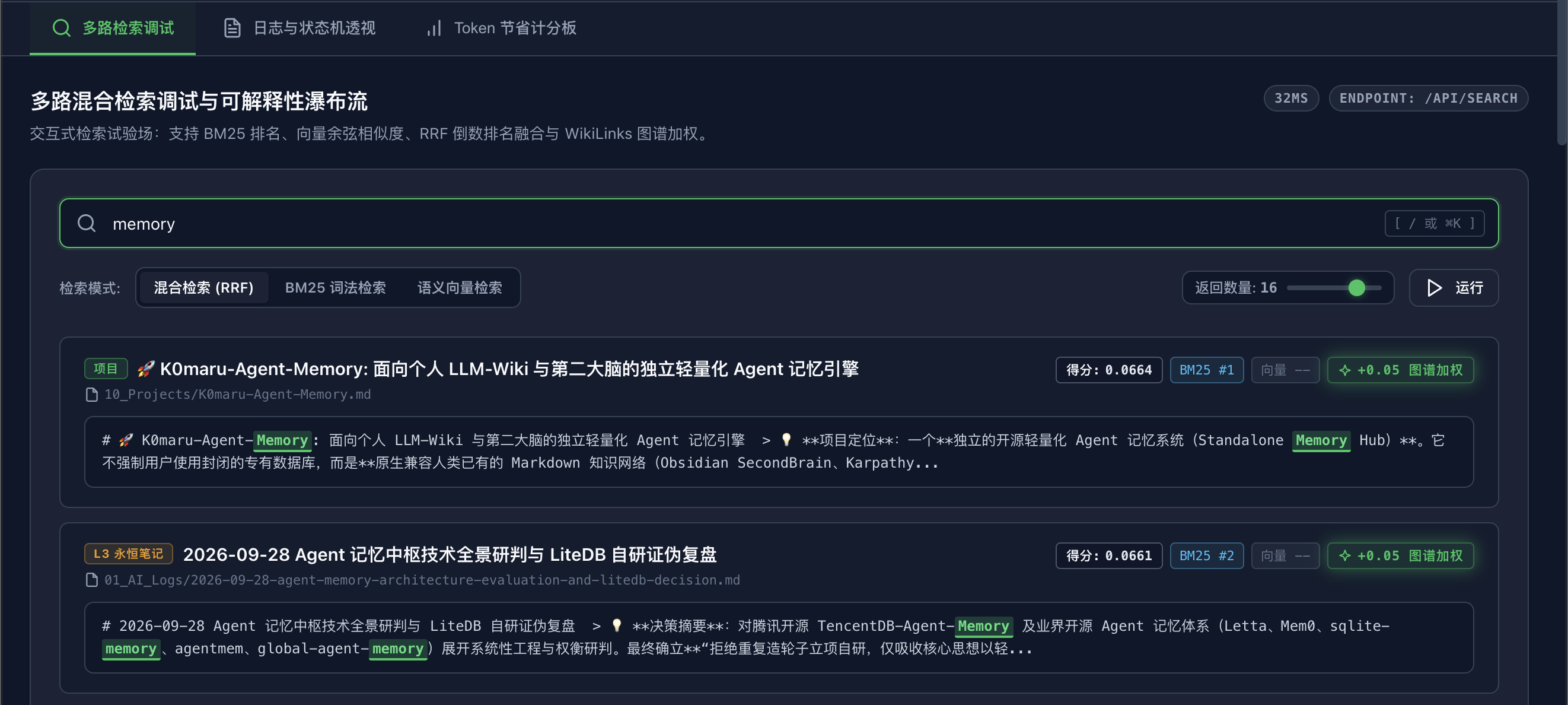
Architectural Highlights
- Single-binary distribution: Uses the Axum HTTP framework and embeds HTML, CSS, JS, and SVG assets via
rust-embed. Requires no Node.js or Nginx installations. - Search debugger: Displays BM25 ranks, vector cosine scores, and highlighted Emerald
+0.05 Graph Boostbadges for every candidate result. - Token scoreboard: Calculates cumulative tokens saved by log offloading and estimates cost reductions across frontier LLM API tiers.
- Dark cockpit theme: Matches the
#0F172Abackground and#22C55Eaccent colors of the terminal interface. - Clean exit: Pressing
Ctrl+Cterminates the HTTP server and releases bound ports immediately.